


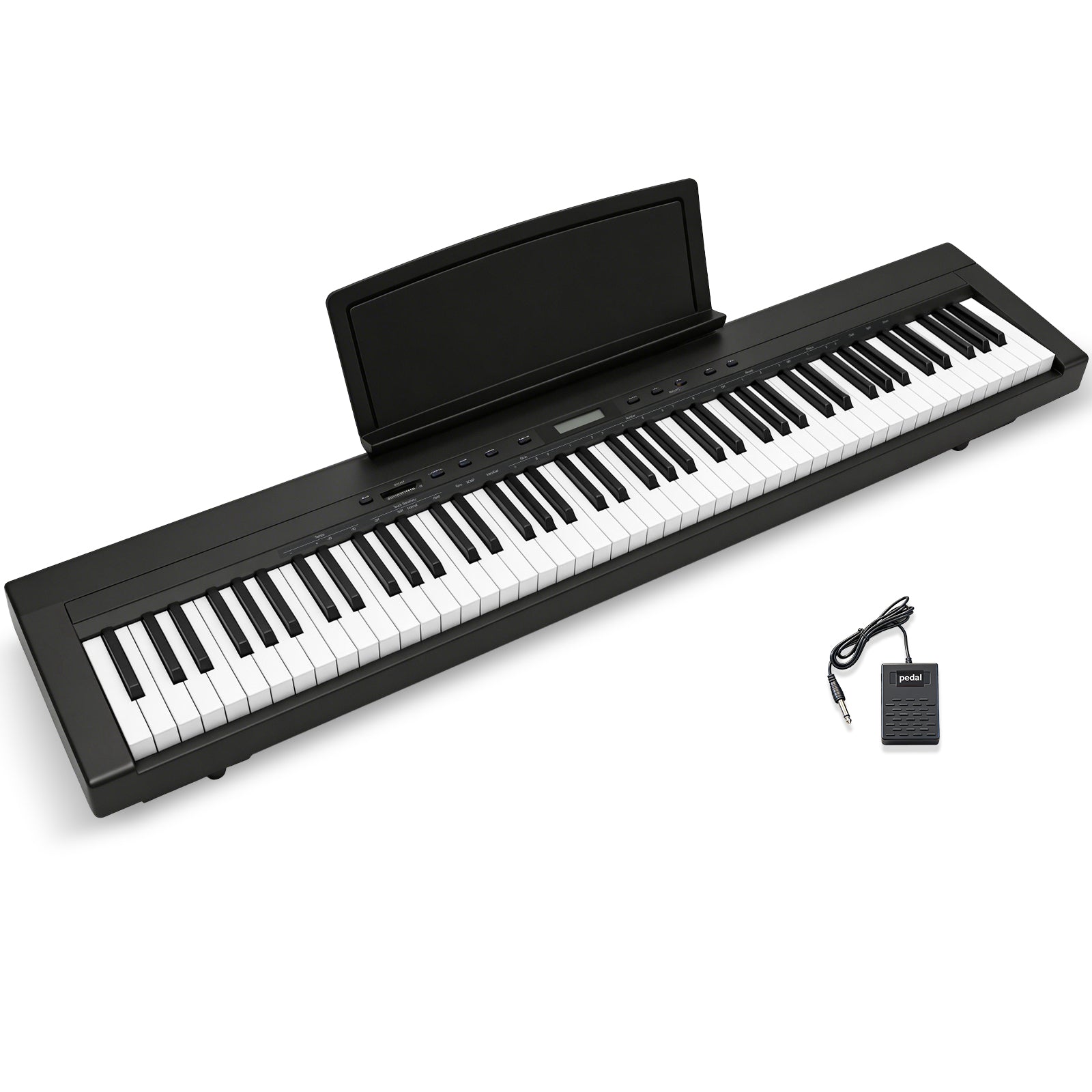


GOLDRIFF 88-Key Graded Hammer Action Keyboard
Key Feature
88 GRADED HAMMER ACTION KEYS — TRAIN LIKE A REAL PIANIST FROM DAY ONE Progressive weighting — heavier in the bass, lighter in the treble — builds real finger strength and technique. The same key feel used for serious practice at every level, from beginner to advanced.
FRENCH DREAM SOUND ENGINE — 128-NOTE POLYPHONY, 238 VOICES, 200 RHYTHMS, 100 DEMO SONGS Powered by a 30-year European audio specialist, 128-note polyphony ensures no notes drop during complex chords or pedal use. Everything you need to practice, explore, and perform right out of the box.
50W STEREO SPEAKERS + BLUETOOTH + FULL CONNECTIVITY Twin 25W speakers fill any room with balanced stereo sound. Stream backing tracks wirelessly via Bluetooth, connect to recording software via USB-MIDI, or play MP3s directly through the USB-A port.
DUAL HEADPHONE JACKS + KEYBOARD SPLIT — PERFECT FOR LESSONS AND LATE-NIGHT PRACTICE Two headphone ports let a student and teacher listen simultaneously — no splitter needed. Keyboard split divides the 88 keys into two zones so two players can practice side by side on one instrument.
PORTABLE DESIGN WITH DETACHABLE MUSIC STAND Slim, lightweight body moves between rooms or packs for lessons with ease. The music stand attaches and collapses in seconds. Just unfold, connect, and play.
Specifications
What's In The Box
Shipping & Returns
Free Shipping on Every Order
All GoldRiff orders ship free via FedEx within the contiguous 49 United States.
How Fast Will I Get My Order?
Most orders are processed within 1–2 business days and delivered within 3–5 business days total. You will receive a tracking number via email as soon as your order ships.
30-Day Return Policy
Changed your mind? You have 30 days from delivery to return any unused item in its original packaging for a full refund.
How to return:
- Email support@goldriff.com with your order number
- We will send you a prepaid return label
- Ship the item back to us
- Refund processed within 5–7 business days after we receive the item
Items must be in original, unused condition with all accessories and packaging included. Opened items showing signs of use may be subject to a restocking fee.
Exchanges
Want a different color or model? Contact us and we will arrange an exchange at no extra cost, subject to availability.
Damaged or Defective Items
Received a damaged or defective product? Contact us within 48 hours of delivery with photos of the issue. We will send a free replacement right away — no need to return the damaged item first.
Warranty
1-Year Limited Warranty
Every GoldRiff instrument is backed by a 1-year warranty from the date of purchase, covering defects in materials and workmanship.
Covered: Structural defects, electronic failures, hardware malfunctions, and finish defects under normal use.
Not covered: Normal wear and tear, damage from misuse or accidents, unauthorized modifications, and consumable accessories.
How to claim:
- Email support@goldriff.com with your order number and photos or video of the issue
- Our team responds within 24 hours
- We ship free replacement parts or a replacement unit as needed
For the full warranty and return policy, visit our Refund Policy page.
Free Shipping (1-3 Days Delivery)
30-day Risk-free Trial & 1-year Warranty
Step-by-Step Learning Center Included
Share this with a fellow musician:
Complete Your Setup
GOLDRIFF 88-Key Graded Hammer Action Keyboard
Explore our free resources to find the perfect instrument for you.
-
Buying Guide
Not sure which model is right for you? Our buying guides break down everything — Written by musicians, not salespeople.
👉 Read Our Buying Guides
-
Free Lessons & Tutorials
Just getting started? Our Classroom has step-by-step tutorials for absolute beginners — from how to tap your first finger to playing your first song. All free, all designed for GoldRiff instruments.
-
Expert Reviews
Want an unbiased take? Our expert reviews cover sound quality, build, playability, and value — with real audio demos and side-by-side comparisons.
👉 Read Expert Reviews

More than just a piano—it’s a beautiful addition to your home
One Piano, Every Story


It's not just the piano—there's so much more
🎧 Dual Headphone Output
🔊 50W Speaker System
👜 Portable and Easy to Carry
🎓Free structured lessons, from Day 1
A 30-day beginner curriculum included in every box. No subscription, no trial period — scan the card, start playing. Real music in 3 minutes.

What Makes GOLDRIFF Better

Study
Free Online Courses
Get free access to exclusive online courses—no payment required—to meet your basic and advanced learning needs. Simply visit the Classroom in the Learning Center to begin your learning journey.

Audio source
French Dream
Features high-precision multi-stage sampling, supports a wide range of polyphony, and delivers sound quality comparable to professional pianos

Keyboard weighting
Graded Hammer Action

Multi-function interface
Bluetooth support
Supports multiple interfaces and Bluetooth to meet your various needs and enhance your playing experience.

Performance
Multifunction button
The instrument's control panel features a variety of buttons, allowing you to easily explore different modes and tones.
WHY GOLDRIFF SOUNDS THIS GOOD
“GoldRiff instruments are built on the same production lines as the world’s #1 musical instrument brand. We’ve cut the middlemen, not the quality — delivering professional-grade instruments directly to your door at honest prices.”
Every guitar undergoes a 12-point quality inspection before it’s packed. Our HSS pickup configuration, Canadian maple neck, and precision-wound strings are the same components used in instruments twice the price.

Precision Craftsmanship
"Every GoldRiff instrument is manufactured in our state-of-the-art facility using advanced precision machinery and time-honored craftsmanship techniques. We combine industrial excellence with artisanal expertise to create instruments that deliver professional-grade performance at exceptional value."
Our rigorous 12-point quality control process ensures every instrument meets our exacting standards before leaving the factory. From wood selection and component assembly to final setup and testing, each step is meticulously monitored to guarantee durability, playability, and sonic excellence."
Get it for just $299
Set up the French Dream Sound Source
First-tier Manufacture & Premium Quality
Free shipping and returns
Why It's Right for Your Family
AT $179, HERE'S WHAT OTHERS DON'T GIVE YOU
France's Dream Chip - High-Quality Audio Source
Most digital pianos under $300 don't tell you what's inside making the sound.
There's a reason for that.
GoldRiff tells you. Every GoldRiff piano is powered by the French DREAM Sound Engine — a professional-grade audio chip made by DREAM S.A.S. in France.
What does a sound engine actually do?
Every time you press a key, something has to decide what that note sounds like. How warm. How bright. How long it sustains before it fades. How different it sounds when you play softly versus when you strike hard. That decision happens inside the sound chip — in milliseconds, invisibly, on every single note.
A cheap chip gives you a flat, plasticky piano sound. You've heard it. It sounds like a toy.
A professional chip — like the French DREAM engine — processes audio at 24-bit depth, which means more dynamic range, more tonal nuance, and a more natural response to how you play. The difference isn't subtle. You feel it the first time you play softly into a quiet chord and hear it actually breathe.
Where does this chip normally show up?
DREAM's audio processors are designed for professional keyboards, digital organs, studio instruments, and high-end sound modules. They're the kind of components instrument engineers specify when sound quality is non-negotiable.
GoldRiff brings that same processing foundation to a $179 home piano and a $299 portable piano.
What does it mean for your playing experience?
The DREAM engine affects three things you'll notice immediately:
Velocity response — How the note changes based on how hard you press. With a generic chip, soft = quiet and loud = louder. With DREAM processing, soft playing produces a genuinely warmer, rounder tone. The dynamic range feels real.
Sustain character — The way a note decays after you release the key. Cheap chips cut this short or make it sound abrupt. DREAM sustain fades the way an acoustic piano fades — gradually, naturally, with harmonic richness at the tail.
Reverb and effects depth — The built-in reverb isn't a thin echo layer on top of the sound. It integrates with the note itself, the way a room actually sounds around a piano.
The honest question: does the sound chip matter on a beginner piano?
Yes — and especially for beginners. Advanced players compensate with technique. Beginners are forming their first impression of what a piano should sound like and feel like. A piano that sounds dull and artificial creates a subtle friction every time you sit down to practice. A piano that sounds alive makes you want to keep going.
The first 90 days are when most people quit. Sound is part of why.
Three-pedal - Experience the feel of a real piano
Most digital pianos under $300 come with one pedal. A single sustain pedal, shipped in a small box, plugged into a port on the back.
GoldRiff comes with three.
Every GoldRiff Home Piano and Studio Piano includes a full triple-pedal unit — the same pedal configuration found on every acoustic piano ever built, from a $500 upright to a $150,000 Steinway concert grand.
What does that actually mean when you play?
A real piano has three pedals. Each one does something completely different. Most beginners only know about one of them — because that's all they've ever had.
Here's what you've been missing.
The Right Pedal — Sustain (the one you know)
This is the pedal everyone uses. Press it, and every note you play rings freely instead of stopping when you lift your finger. It's what makes piano music sound full rather than clipped. Without it, even a simple melody sounds mechanical. Every single-pedal piano includes this one. It's the minimum.
The Left Pedal — Soft Pedal (the one that changes everything)
Press the left pedal, and the entire character of the piano shifts. The tone becomes quieter, yes — but more than that, it becomes warmer. More intimate. Less attack, more breath. It's how pianists play lullabies. How they play the quiet section after a loud climax. How they play anything that needs to sound like a whisper instead of a statement.
Without this pedal, you have one volume setting: whatever your fingers give you. With it, you have a second voice — soft, rounded, close. Beethoven wrote entire movements to be played with it held down the whole time. You cannot play those pieces correctly on a single-pedal piano. You physically cannot.
The Middle Pedal — Sostenuto (the precision tool)
This is the pedal that separates pianists from people who play piano. Press a chord in the bass, then press the middle pedal while holding those notes — and only those notes will sustain, even after you lift your hands. Everything else you play above them stays dry and clear. You get a rich, ringing foundation in the left hand while playing a clean melody with the right.
It is how the left hand of a Chopin nocturne actually works. It's how jazz pianists hold a bass note under a walking line. It is an entire dimension of musicality that a single sustain pedal cannot access — not even close.
What happens when this pedal is missing
You adapt. You find workarounds. You practice pieces in a version that isn't quite right, and you don't realize it until much later — when a teacher corrects you, or when you sit at a real piano and your foot reaches for something that isn't there.
Many beginners spend a year on a single-pedal instrument and then discover, when they try a full piano, that half their technique is wrong. Not because they didn't practice. Because the instrument didn't let them practice correctly.
Multifunctional Bluetooth Interface — Meet a variety of needs
Most digital pianos treat Bluetooth as a checkbox. It's listed in the spec sheet. Nobody explains what it actually does.
GoldRiff doesn't have one kind of Bluetooth. It has three — and each one unlocks a completely different way of using your piano.
What does that actually mean the moment you sit down?
"Bluetooth" on a piano spec sheet tells you almost nothing. Bluetooth for what? Connecting to what? Doing what, exactly? The word gets listed alongside "128 voices" and "sustain pedal" as if it's all the same category of feature. It isn't. Bluetooth on a piano can mean three entirely separate things — and knowing the difference changes how you practice, how you learn, and how the instrument fits into your life.
Mode 1 — Bluetooth Audio In: Your Piano Becomes a Speaker
Open Spotify. Put on a backing track in the key of C. Connect your phone to the GoldRiff wirelessly — and now that track plays through the piano's speakers while you play along on the keys, in the same room, through the same sound system, at whatever balance you choose.
This is how musicians have always learned by ear. You find a song you love. You listen. You play. You listen again. The difference is that without Bluetooth Audio, you're managing two separate sound sources — phone speaker over there, piano speaker over here — and the blend is never right. With it, everything comes from one place. The music and your playing occupy the same space. That's not a convenience feature. That's the difference between practicing with a track and actually playing with a track.
Mode 2 — Bluetooth MIDI: Your Piano Talks to Learning Apps
This is the one most beginners don't know exists — and the one that changes learning completely.
Apps like Simply Piano, Flowkey, and Playground Sessions can listen to what you play in real time and respond: showing you which notes were right, slowing down when you make a mistake, unlocking the next lesson when you pass this one. They turn a passive video lesson into a conversation.
But they can only do this if the app can hear your piano. Without MIDI connectivity, the app is blind — it can't receive any signal from the instrument. Without Bluetooth MIDI specifically, you need a USB cable running from the piano to a phone or tablet, which means a dongle, a cable draped across the floor, and a setup that needs to be reassembled every time you sit down.
Bluetooth MIDI removes all of that. Your phone sits on the music stand. The app opens. The piano connects. You play. The app listens. No cable. No adapter. No friction between sitting down and starting.
Most people who buy a piano without Bluetooth MIDI discover the apps they wanted to use don't work properly — after they've already bought the piano.
Mode 3 — Bluetooth Audio Out: Practice at Midnight, Disturb Nobody
This is the one that makes apartment living with a piano actually work.
Connect any Bluetooth headphones — AirPods, Sony WH-1000XM5, whatever you already own — and the piano's sound routes entirely to your ears. No speaker output. No sound escaping into the room. You hear every note in full fidelity, with the depth and warmth of the French DREAM sound engine, while the room stays completely silent.
It's 11pm. Your partner is asleep. Your neighbors share a wall. Without this, you either don't practice — or you plug in a wired headphone and manage the cable draped across your hands for the next hour. With it, you sit down, connect in three seconds, and play for as long as you want. Nothing changes in the room. Everything changes in the headphones.
This matters especially for the people most likely to be buying a first piano: adults in apartments, people with families, anyone whose living situation means that playing out loud is a privilege, not a default. For them, wireless headphone practice isn't a nice-to-have. It's the reason they can practice at all.
What happens when none of this exists
You practice with your phone propped against the music stand playing through a tiny speaker, while the piano plays through its own speakers at a completely different volume. You skip the learning apps because the setup is too cumbersome. You stop playing after 9pm because someone will complain. Every one of these is a small friction. Small frictions, compounded across months of practice, become the reason people stop playing.
Includes online courses-Supporting Your Learning
Most piano brands ship you an instrument. A box arrives. You unbox it alone. Then you sit in front of 88 keys with no idea what to do next.
Every GoldRiff piano comes with something no competitor puts in the box: a complete learning system, free, that begins the day you start playing and keeps growing for as long as you own the piano.
Three tiers. One direction: forward.
Tier 1 — Foundations: Learn to Play Before You Learn to Practice
Most beginners make the same mistake. They sit down at a new piano, press a few keys, feel lost, and open YouTube. Twenty minutes later they've watched four different tutorials that contradict each other, learned nothing that connects, and quietly closed the lid.
The Foundations course exists to prevent that exact moment.
It starts where you actually are: knowing nothing. Not knowing what the notes are called. Not knowing which finger goes where. Not knowing how to read a single symbol on a sheet of music. That is the correct starting point, and there is no judgment in it — every pianist who ever lived started there.
The course moves in one line. How the keys are laid out, and why. How to find any note without looking down. How to read rhythm before pitch, because rhythm is what makes music feel like music rather than a sequence of correct sounds. How both hands find their positions, and how they begin — slowly, imperfectly, then less imperfectly — to work together.
By the end of Foundations, you can read basic sheet music and play it. Not every piece. Not without effort. But the language of the instrument is no longer foreign. You know what you're looking at when you open a score. That is the difference between a beginner who progresses and one who stays a beginner indefinitely.
Tier 2 — Features: The Instrument You Thought You Already Knew
Most players use 20% of their piano's capability for years — not because the other 80% is too difficult, but because nobody ever showed it to them.
The Features course closes that gap.
Your piano has a metronome. Most beginners turn it on, find it annoying, and turn it off. This course shows you how to use it correctly — not as a rigid enforcer, but as a tool for finding the exact tempo where you can play something cleanly, then nudging it upward week by week until the difficult passage becomes easy at full speed. This is the single most effective practice technique that exists, and it takes three minutes to learn.
Your piano has a recording function. Most players never press the button. Recording yourself — even badly, even just for 60 seconds — reveals errors that your ears miss in real time because your brain is too busy playing to listen. Hearing yourself back is uncomfortable the first time. It is also the fastest way to improve.
Your piano has a split mode, a dual-voice layer, a transpose function, a built-in rhythm section. Each one sounds like a feature for advanced players. Each one becomes useful the moment someone explains what it actually does and why a beginner would reach for it.
The Features course is not about complexity. It is about fluency — knowing your instrument well enough that it never gets in the way of your playing.
Tier 3 — Monthly Songs: Something New, Every Month, Forever
This is the tier that solves the problem every other learning system eventually runs into: running out of things to play.
Every month, new songs are added to the library. Simplified arrangements of current titles, seasonal pieces, classics that have never gone out of style, songs requested by the GoldRiff community. Every song comes with a dedicated lesson video — not just sheet music dropped into a folder, but a teacher walking through the tricky passages, showing the fingering, explaining where most players stumble and why.
The library compounds. Month one: ten songs. Month six: sixty songs. Month twelve: over a hundred pieces you can sit down and play, at different difficulty levels, in different styles, for different moods and occasions.
This matters because motivation is fragile. The moment you feel like you've played everything available, the piano starts collecting dust. A library that keeps growing means there is always a next song — always something slightly beyond your current level that pulls you forward, and something comfortably within your level that reminds you how far you've already come.
What this costs
Nothing. It is included with every GoldRiff piano, from the day the box arrives.
No subscription. No monthly fee. No "first 30 days free, then $9.99." You buy the piano once. The learning system is yours.
RESOURCES
Step-By-Step free Lessons

Buying Guides

Expert Reviews

24/7 Customer Support


Common Questions
Please read our FAQs page to find out more.
Is the wood finish real wood or just a plastic wrap?
The tapered legs and triple pedal base are solid wood. The cabinet surface uses a genuine wood-grain veneer — not a sticker, not paint. When it's sitting in your living room, it looks like a piece of furniture. Because it is.
What does "semi-weighted" mean, and is it right for me?
Semi-weighted keys have a light, responsive touch — easier to press than a fully weighted piano, but with more resistance than a cheap keyboard. It's the right choice if you're a beginner, a casual player, or buying for a child. If your goal is serious practice, exam preparation, or matching the feel of an acoustic piano, our Studio Piano (fully weighted) is the better fit.
Can my child use this comfortably?
Yes. Semi-weighted keys require less finger strength, which is exactly why we chose them for this piano. Children five and older can play without fatigue. It's also one of the reasons families tell us this is the piano everyone in the house actually uses — not just the one who "takes lessons."
Is the built-in speaker loud enough?
The GOLDRIFF wooden digital piano has 6W × 2 speakers (12W total), which fills a standard living room or bedroom comfortably. It's not designed for performance or large spaces. If you need stage-level volume, our Portable Piano (50W total) is built for that.
Can I practice with headphones at night?
Yes. The GOLDRIFF wooden digital piano has a headphone jack so you can play at any hour without disturbing anyone. This is one of the features families with young children mention most.
Do I need to assemble it?
Yes, but it's simple. You'll attach the tapered legs to the piano body and connect the pedal unit. No special tools required. Most customers finish assembly in 15–20 minutes. Step-by-step instructions with diagrams are included.
What if I don't like it? Can I return it?
We offer a 30-day hassle-free return policy. Email support@goldriff.com, we'll send you a prepaid return label, and your refund is processed within 5–7 business days. No questions asked.
Can I practice without disturbing my roommates?
Yes. The amp has a 3.5mm headphone output for completely silent practice. Plug in any standard headphones and play at any hour without bothering anyone. Perfect for apartments and shared spaces.